
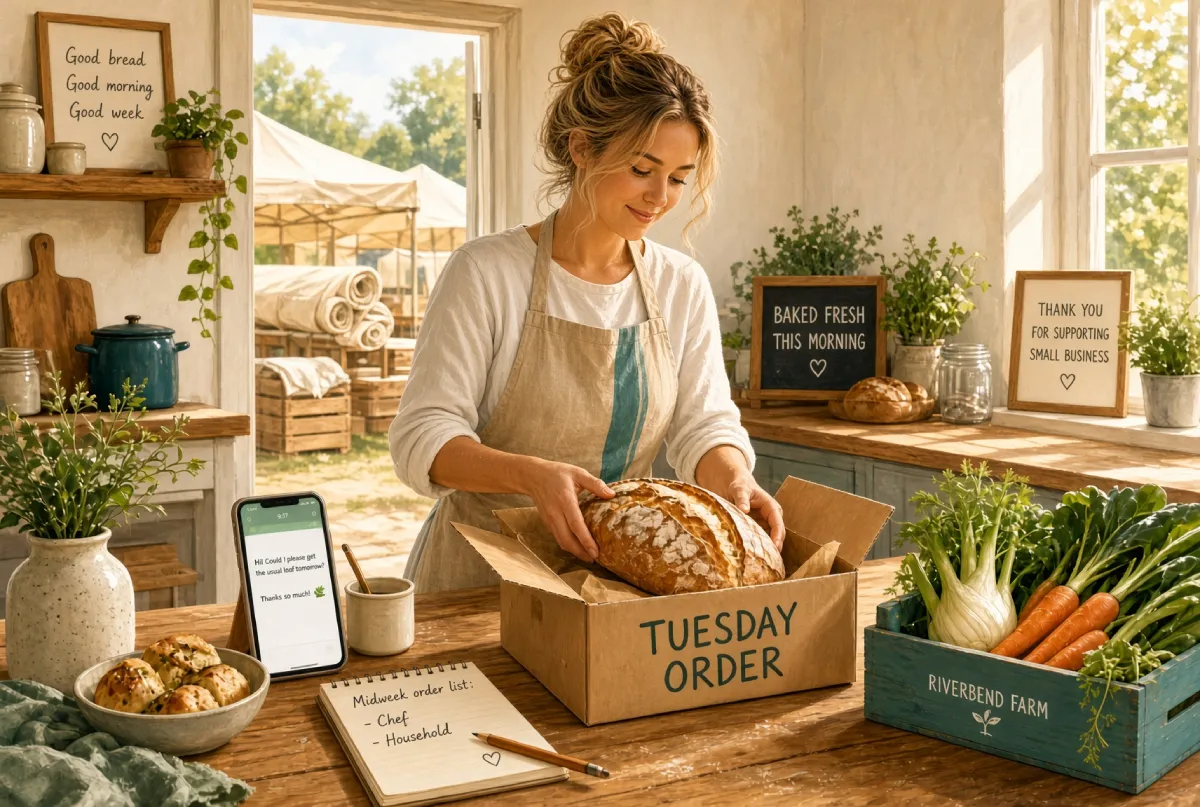
The Midweek Order Is the Real Farm Business
Saturday proves people want you. Tuesday is whether the city can still buy.

Written by
FinTechful Editorial
Editorial Staff
FinTechful perspectives on financial opportunity, healthy mind & body, farming, local food, and the homes and communities we care for.
View more editorial insightsTaxonomy
Key Takeaways
- A packed stall is demand with a face on it. It is not the whole company.
- The household still eats on Wednesday. The restaurant still plates on Thursday.
- Midweek business needs a door that is not the next market map.
- The question is not “online or Saturday.” It is which record still sounds like you.
- A standing order — loaf, box, wholesale — is how the stall continues after the tents come down.
- Treat the market as the tasting room. Treat Tuesday as the work.
Saturday works. People walk up. They see the food. They talk to the person who grew it or baked it. They taste something. They buy. If you are good, you sell out.
That morning is not a hobby. It is one of the few local directories that still functions: face, product, proof, a conversation. No auction in front of the tomatoes.
Then Monday comes.
Someone who missed the line wants the same loaf. A chef wants a standing order. A household would add you to the week if they could find you without waiting for the next market map. They search. They get a dead page, last year’s photos, or a marketplace that treats you like a SKU.
The stall worked. The rest of the week did not catch it.
This is not an argument for leaving Saturday. You would not tell a winery to shut the tasting room because bottles also exist. You also would not tell them the tasting room is the company. Selling out every week is the beginning of doing business in the city. The next step is a way to buy on Tuesday that still sounds like you.
A generic listing that dumps you into the same pile as everyone else is a worse version of not being found. An empty page trains people to wait until Saturday and hope you still have inventory. A page with your name, what you actually sell, when you will be at market, and how to start a midweek order — that is the stall continuing after the tents come down.
They did not need twenty options on Saturday. They needed to see you. That is why the market feels healthy. It is also why a thin, copied, or abandoned page feels like a break in the same relationship. They met you. Then the week acted as if you were closed.
Vendors who treat the market as the whole business stay seasonal in a way the demand is not. People still eat on Wednesday. Kitchens still plate on Thursday. If the only door is a Saturday line, good product stays smaller than the city would allow.
Put the week on a record you would send to someone who missed you at ten in the morning. Next market. What you grow or make. Whether you do pre-orders, a CSA, wholesale, or a farm stand. A face. One photo of the actual food. A way to start a conversation that is not a comment that dies on a reel.
Saturday is the tasting room. The midweek order is the business. Sell out in the morning. Be findable when the tents are down.
Related Articles
The Platform Is Finished. Being Found Is the Slow Part.
A free citation page can be search-ready and still invisible. Discovery on this internet is slow — until it isn’t.
The First Wave of Yeses Is How the Loop Starts
One claimed page is a start. Several, given with permission, are enough for work to move from person to person — instead of to whoever paid the most for the slot.
We Are Building the First Pages by Hand — With Permission
A city hub does not fill itself. The unusual offer, at launch, is to curate the first records one business at a time, and never without a yes.