
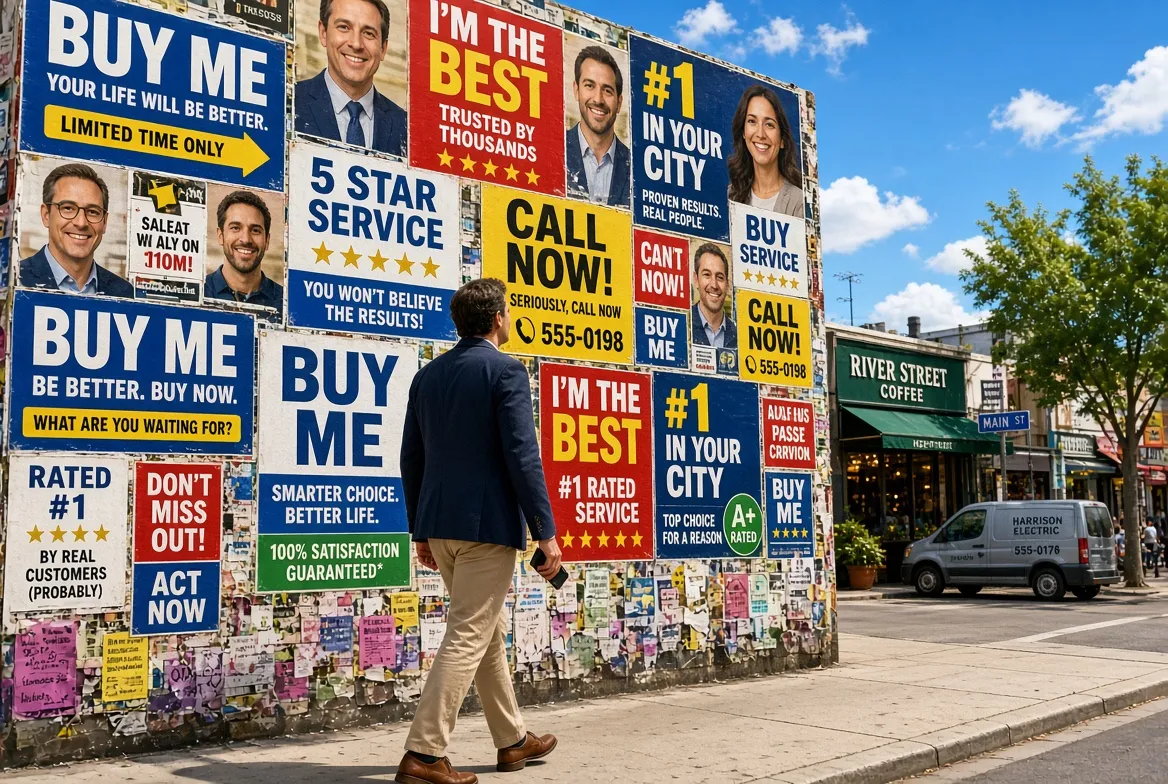
The Internet Gave Local Businesses Slots. Most of Them Never Held.
Search, maps, and marketplaces created slots for local businesses — then those slots became unreliable, empty, or owned by whoever could dominate traffic. Why better matches stay hidden, and what a local ecosystem has to rebuild.

Written by
FinTechful Editorial
Editorial Staff
FinTechful perspectives on financial opportunity, healthy mind & body, farming, local food, and the homes and communities we care for.
View more editorial insightsTaxonomy
Key Takeaways
- The internet created slots for local businesses, then let most of them go stale, empty, or rented.
- A slot only produces a good match if it stays accurate, claimed, and specific about who the provider helps.
- Reviews vouch. They do not fix a missing operator or a slot owned by traffic tactics.
- Visibility stacked toward a few effective players; better fits stayed off the ready view.
- Hollow listings teach people the city is empty and teach owners that claiming is pointless.
- An even local field is owned records, context, and a path to a real conversation — built in the city, not borrowed from consolidated search.
The internet did not fail to create a place for local businesses.
It created too many places, then let most of them go dead.
A slot on a map. A slot in a directory. A slot in a marketplace. A slot on page one. Each one promised the same thing: someone nearby needs help, you are qualified, the two of you should find each other. For a while that felt like progress. Then the slots stopped behaving like infrastructure and started behaving like rented attention.
That is the visibility problem nobody names cleanly. It is not that talent left the city. It is that the places people look are fractured, inconsistent, and easy for a handful of operators to occupy.
A slot is only useful if it stays true
People do not search for “ecosystem.” They search for a CPA before tax season, a contractor after a leak, a coach when the week stops working, a lender when payroll gets tight.
What they get is a pile of slots with no shared standard.
Some are abandoned. The phone number is old. The hours are wrong. The person sold the business two years ago. Some were never adopted because the owner tried once, saw no calls, and decided “online doesn’t work.” Some are technically live and still empty of the only information that makes a match: who this person actually helps, how they work, and whether they are still in the market.
Reviews help. A verified voucher is better than a dark profile. Reviews do not solve the deeper issue. They sit on top of a slot that may already be the wrong slot, owned by the loudest listing, or missing the better operator entirely.
A match is not “someone appeared.” A match is the right person, with enough signal to decide, in time to act. That outcome is not consistently available. That is why so many local hires are still first-yes hires.
Traffic consolidated. Slots did not stay even.
As search, maps, and platforms matured, visibility stopped spreading and started stacking.
A small number of businesses learned the game early: reviews at volume, content at volume, ads on the exact category terms, listings on every property that sends a lead. That is not immoral. It is effective. It is also how a city starts to look like it only has five options in a field that has fifty.
The cost is hidden. The better bookkeeper never appears. The contractor who would have been the honest fit is on page four, or on no page, because they refused to play a channel that felt like a lead tax. The best product in a category can be fully absent from ready view — not because it failed in the real world, but because the slots that carry attention were limited, captured, or given up on.
Location search fractured the same way. One map, one marketplace, one “near me” result set, each with different records for the same business, none of them fully claimed, none of them talking to each other. The seeker does the unpaid work of reconciliation. Most seekers will not. They will click what loads with proof and a button.
That is how match-making quietly became a traffic business instead of a local-introduction business.
Empty slots train people to leave
This is the part that looks like an empty city.
A hub, a category page, a map pack with hollow listings does not read as “opportunity.” It reads as “nothing here.” People bounce to the national platform they already distrust but at least recognize. Professionals see the same empty shelf and decide claiming another profile is a waste of time. The loop tightens.
Unclaimed is not a paperwork status. It is a broken promise in public. It tells the next visitor that this market does not maintain its own record of who does the work.
Claimed is the opposite only if the claim is real: facts corrected, a person attached, context added, a next step possible. A claimed slot that still says nothing is just a branded vacancy.
What an even field actually requires
FinTechful’s work starts from that fracture, not from a slogan.
Local ecosystems do not appear because a platform announces them. They have to be built in the city, from the operators who already exist, in public records those operators control. An even playing field is not “everyone ranks #1.” It is:
- a slot that belongs to the business, not to last quarter’s ad budget
- enough context to judge fit, not just a category tag and a star average
- room for the quiet operator to stand next to the loud one
- a path into a conversation, a collaboration, or a funding step without leaving the local map
Transparency is the mechanism. Collaboration is the outcome. Conversations are how work actually moves.
That cannot be assembled from leftover slots on networks that already consolidated. It has to be grown on purpose: claimed, current, local, and usable on an ordinary Tuesday when someone in that city finally needs help.
The experts were never missing. The reliable slot was.
Related Articles
The Platform Is Finished. Being Found Is the Slow Part.
A free citation page can be search-ready and still invisible. Discovery on this internet is slow — until it isn’t.
The Midweek Order Is the Real Farm Business
Saturday proves people want you. Tuesday is whether the city can still buy.
The First Wave of Yeses Is How the Loop Starts
One claimed page is a start. Several, given with permission, are enough for work to move from person to person — instead of to whoever paid the most for the slot.