The Strength of a Local Ecosystem Is Found in Its Connections
When financial professionals, growth experts, home service providers, and local food businesses combine their expertise and relationships, communities gain more than isolated services—they gain a durable network of opportunity, trust, and care.

Written by
FinTechful Editorial
Editorial Staff
FinTechful perspectives on financial opportunity, healthy mind & body, farming, local food, and the homes and communities we care for.
View more editorial insightsTaxonomy
A local economy is often measured by visible activity: the number of businesses, jobs, transactions, new buildings, or customers moving through a downtown area.
Those measures matter, but they do not tell the whole story.
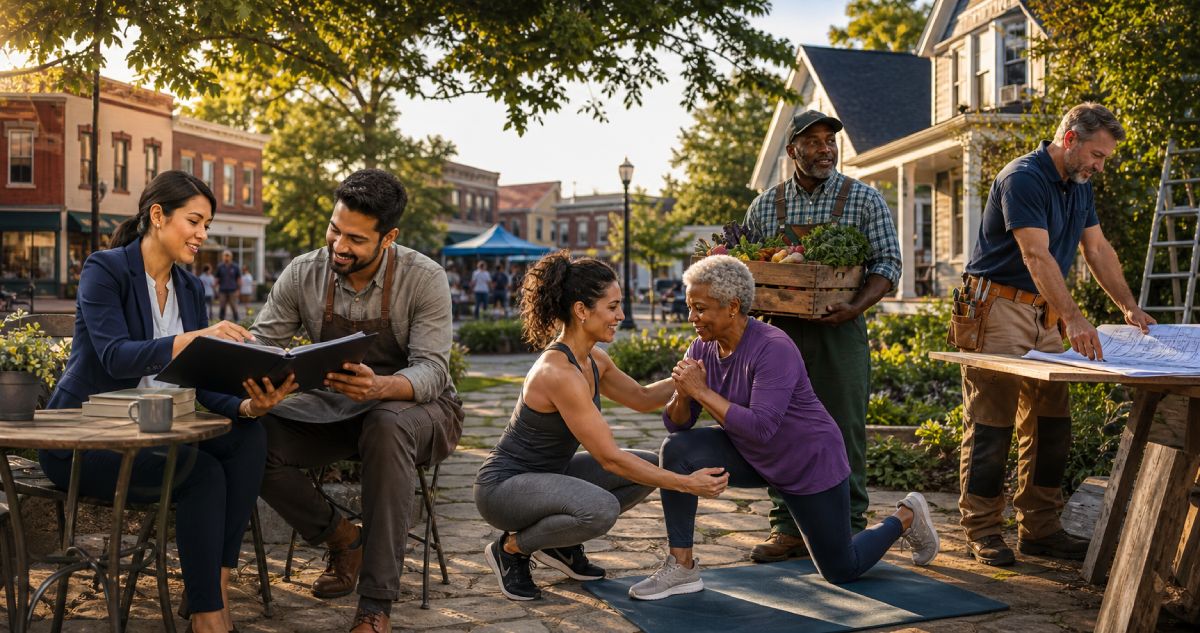
The deeper strength of a community is often found in the relationships connecting its people. It can be seen when a financial professional helps a business owner understand available funding options, when a coach helps that owner build the confidence and discipline to grow, when a trusted contractor improves the space where the business operates, and when a local farmer or food vendor helps keep more economic value circulating close to home.
Each professional may have a distinct specialty. Their work may look unrelated at first. But together, their expertise supports many of the same goals: healthier households, stronger businesses, more resilient neighborhoods, and a greater sense of shared possibility.
A local ecosystem becomes powerful when these connections are intentional.
Specialization is a source of strength
Strong local ecosystems do not require everyone to do everything. In fact, they become more capable when people develop deep expertise in specific areas.
A financial professional may understand capital structure, lending options, cash flow, wealth planning, or business financing. A growth professional may help people improve their habits, leadership, communication, performance, or overall wellbeing. A home service professional may know how to design, build, repair, maintain, or improve the physical spaces where people live and work. A small farmer or local food vendor may understand cultivation, sourcing, preparation, hospitality, and the values behind responsible food production.
Specialization creates quality because it allows professionals to focus. It also creates clarity. People know where to turn for a particular need, and trusted referrals become easier to make.
But specialization works best when it is connected to a broader understanding of community life.
A business owner struggling with growth may not need only a loan. They may need better financial organization, more confidence, improved operations, a healthier routine, a better workspace, or stronger relationships with customers and vendors. No single professional needs to solve every part of that challenge. A connected network can help the right expertise reach the right person at the right time.
Four groups with a shared interest in local wellbeing
The people who make up a local ecosystem may serve different industries, but their work often overlaps in meaningful ways.
Financial professionals
Financial professionals help people and businesses understand choices involving money, capital, planning, and risk. This can include wealth professionals, funding providers, financial advisors, and specialized service providers.
Their contribution is not limited to access to capital. They can also help clients ask better questions:
- What is the actual need?
- Which funding structure may fit the situation?
- What information should be prepared?
- What risks or obligations should be understood?
- Which other professionals could improve the outcome?
Financial access should not be confused with guaranteed approval or guaranteed results. Every funding decision depends on individual circumstances, qualifications, terms, and provider requirements. Still, better connections can make the process more informed and more efficient.
Growth professionals
Growth professionals include coaches, instructors, and non-medical health and wellness consultants who help people improve their capacity to act.
Their work may involve leadership, fitness, mindset, communication, business development, personal discipline, or professional performance. They often support the human side of progress—the habits and confidence that allow a person to make better use of new opportunities.
A business owner who receives funding but lacks a clear plan, sustainable routine, or support system may struggle to translate resources into progress. Growth professionals can help people build the capabilities that make progress more durable.
Home service professionals
Home service professionals shape the physical environments where local life happens. Contractors, builders, landscapers, designers, renovators, maintenance providers, and other specialists help people care for and improve homes, businesses, properties, and shared spaces.
Their work can influence safety, productivity, pride of ownership, accessibility, energy use, and neighborhood appearance. It can also create employment and keep spending within the local economy.
A well-maintained property communicates care. A thoughtfully designed workspace can support better business operations. A repaired or improved home can help a family remain stable and invested in its community.
Farms and local food vendors
Small farmers, food producers, markets, caterers, restaurants, and local food vendors contribute to both economic and cultural resilience.
These businesses often carry values that reach beyond the transaction: stewardship, quality, tradition, health, sustainability, and connection to place. They help communities understand where food comes from and create spaces where people meet one another.
Local food systems can also create relationships between farmers, consumers, chefs, retailers, event organizers, and other businesses. Their strength comes not only from what they sell, but from the network of trust and participation surrounding them.
The multiplier effect of relationships
When professionals work in isolation, each interaction usually ends with one transaction. When they work as part of a connected ecosystem, one interaction can lead to several helpful outcomes.
A local business owner might be referred to:
- A financial professional who can explain appropriate funding pathways
- A coach who can help organize goals and improve execution
- A contractor who can make the business location more functional
- A local food vendor who can support an event or community gathering
The value is not simply the number of referrals. It is the improvement in fit.
A good referral is not a handoff made for convenience or personal gain. It is an informed introduction based on trust, relevance, and respect for the other person’s needs. The professional making the referral should be clear about what they know, what they do not know, and why the connection may be worth exploring.
Over time, thoughtful referrals reduce friction. People spend less time searching blindly. Professionals gain better context before beginning a conversation. Customers are more likely to encounter providers who understand their circumstances.
That is how local opportunity begins to circulate.
Generosity is practical infrastructure
Generosity is sometimes treated as separate from business. In a strong ecosystem, it is part of how business works.
Generosity does not mean giving away professional services without boundaries or ignoring the need for sustainable revenue. It means contributing knowledge, introductions, encouragement, attention, and useful context in ways that strengthen the network.
A professional may be generous by:
- Sharing a resource with someone who is not yet a client
- Introducing two people whose expertise may complement one another
- Offering a practical explanation instead of using unnecessary jargon
- Referring a client to a better-fit provider
- Supporting a local event, market, workshop, or neighborhood initiative
- Giving constructive feedback that helps another business improve
- Making room for newer professionals to build relationships
These actions create trust before a transaction occurs. They also make the ecosystem more resilient because knowledge does not remain trapped inside individual businesses.
The strongest networks are not built only through formal partnerships. They are built through repeated evidence that people are willing to be useful, honest, and respectful.
A practical framework for building local strength
Professionals and organizations can use a simple framework to turn shared values into consistent action.
1. Clarify your specialty
Be specific about what you do, who you serve, and what problems you are best equipped to address. Clear positioning helps others recognize when a referral is appropriate.
2. Identify adjacent needs
Ask what commonly happens before and after your work. A financial provider may encounter clients who need bookkeeping, coaching, construction, legal guidance, or operational support. A contractor may work with property owners who need financing, design, maintenance, or landscaping.
3. Build a trusted circle
Develop relationships with professionals whose standards and values you respect. Begin with conversations, not assumptions. Learn how they work, whom they serve, and where their boundaries are.
4. Create referral clarity
A referral arrangement should protect trust. Discuss expectations around introductions, communication, confidentiality, compensation where applicable, and the importance of avoiding pressure or misleading claims.
5. Share useful knowledge
Offer workshops, guides, checklists, introductions, or educational conversations. Helpful information makes the entire network more capable.
6. Measure relationship quality
Do not evaluate the ecosystem only by leads or revenue. Also consider:
- Are people finding better-fit providers?
- Are referrals handled professionally?
- Are customers receiving clearer information?
- Are businesses collaborating across industries?
- Are local dollars and opportunities circulating more effectively?
- Are relationships becoming more durable over time?
FinTechful’s role as a connector
FinTechful is designed around the idea that stronger communities emerge when people and opportunities are easier to discover.
Its purpose is not to replace the expertise of financial professionals, growth professionals, home service businesses, farms, or local food vendors. It is to help make those specialties more visible and more connected within a local context.
That connection can support better discovery, more informed conversations, stronger referrals, and greater awareness of the resources already present in a community.
The opportunity is especially meaningful because the groups involved share more than geography. They share an interest in helping people build stable, capable, healthy, productive lives. They also share an interest in seeing local businesses succeed without losing the principles and relationships that make a place worth investing in.
A platform can help organize information and create pathways for discovery. The real strength still comes from the people behind the profiles, services, introductions, and decisions.
Building something stronger than a directory
A directory tells people who exists. An ecosystem helps them understand how people can work together.
That difference matters.
A local platform becomes more valuable when it reflects the relationships between needs and specialties. Someone looking for funding may also need a business coach. Someone improving a property may need a designer, landscaper, maintenance provider, or financial resource. Someone hosting a community event may need local food vendors, instructors, sponsors, and professional services.
These connections should never become forced bundles or exaggerated promises. The goal is not to make every interaction complicated. It is to make relevant possibilities easier to see.
The most useful ecosystem is one where people can remain independent while becoming more connected.
Conclusion: Local strength is built through intentional connection
A local ecosystem has no fixed ceiling when its people continue to deepen their expertise while widening their relationships.
Financial professionals, growth professionals, home service providers, farms, and local food vendors each contribute something distinct. Their combined impact grows when they share knowledge, make thoughtful referrals, support one another’s work, and care about the conditions surrounding their businesses.
This kind of strength is not created by one organization or one transaction. It develops through countless practical acts of trust.
The takeaway is simple: identify your specialty, understand the needs around it, build relationships with people who complement your work, and look for ways to make the local network more useful for everyone.
That is how separate businesses become a stronger ecosystem—and how an ecosystem begins to create unbounded local opportunity.
Related Articles
The Platform Is Finished. Being Found Is the Slow Part.
A free citation page can be search-ready and still invisible. Discovery on this internet is slow — until it isn’t.
The Midweek Order Is the Real Farm Business
Saturday proves people want you. Tuesday is whether the city can still buy.
The First Wave of Yeses Is How the Loop Starts
One claimed page is a start. Several, given with permission, are enough for work to move from person to person — instead of to whoever paid the most for the slot.